Museo de Arte Contemporáneo 265 S Church Ave Tucson, AZ 85701
Horario:
Jueves a sábado: 11 AM – 6 PM
Domingo: 11 AM – 4 PM
Lunes a miércoles: Cerrado
520.624.5019 info@moca-tucson.org
Museo de Arte Contemporáneo 265 S Church Ave Tucson, AZ 85701
Horario:
Jueves - Sábado: 11 AM – 6 PM
Domingo: 11 AM – 4 PM
Lunes - Miércoles: Cerrado
520.624.5019 info@moca-tucson.org


Trabajando desde casa: Nuevos encargos de Tucson
Varios artistas
3 de octubre de 2020 – 28 de marzo de 2021
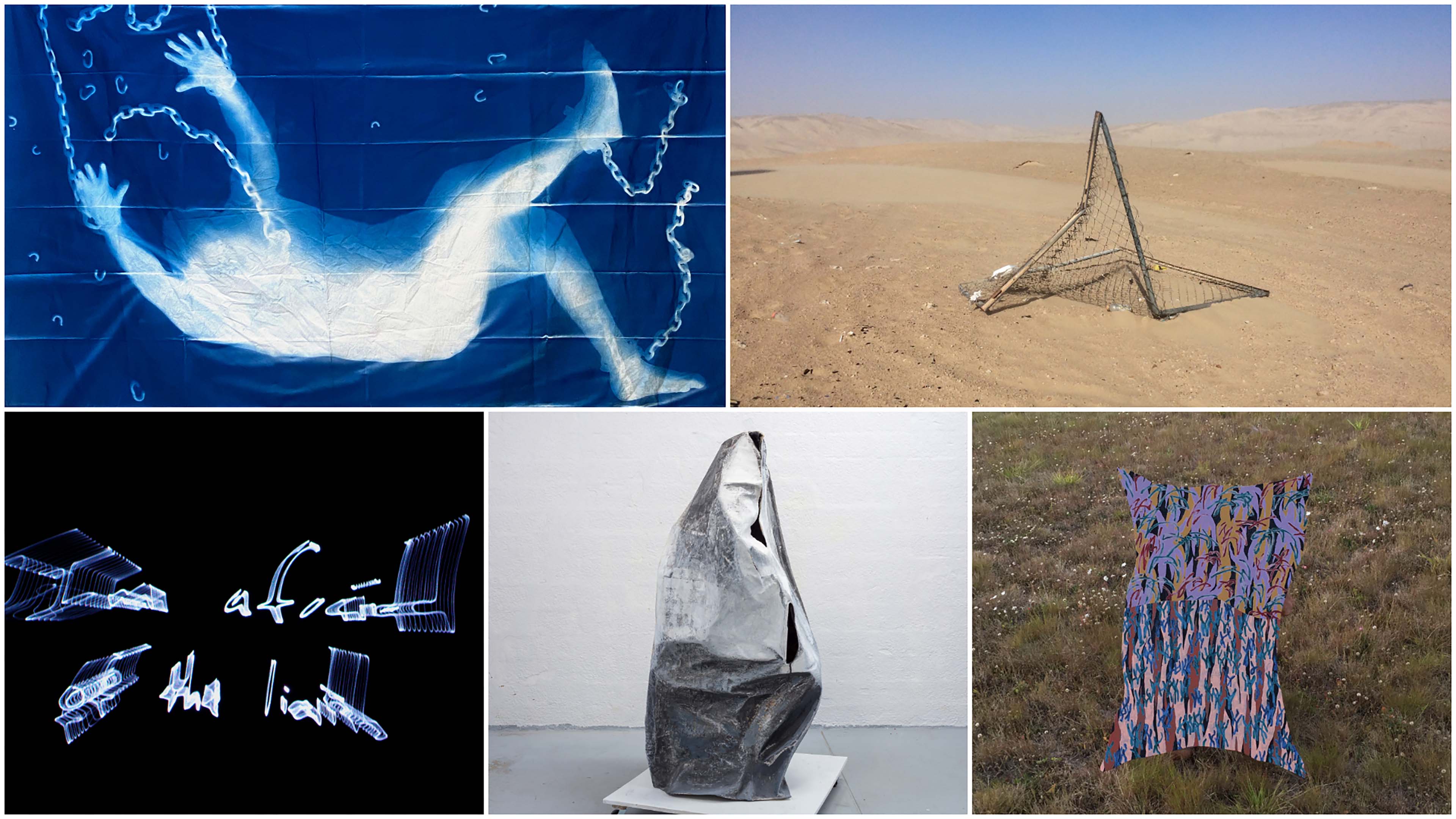
Working from Home (Trabajando desde casa) presenta nuevos encargos de cinco artistas —Miguel Fernández de Castro, Nazafarin Lotfi, Mark McKnight, Nicole Miller y Rocki Swiderski— y dos poetas —Dot Devota y Raquel Gutiérrez—, todos ellos vinculados a Tucson y a la región binacional circundante. Cada colaborador aporta una perspectiva única sobre este momento de pandemia y protesta, así como sobre el paisaje local, gracias a su experiencia actual o reciente de vida, trabajo o cuarentena en la zona. La premisa de la exposición se centra en apoyar directamente la creación de nuevos objetos e ideas, además de destacar la labor esencial que desempeñan artistas y poetas, especialmente durante momentos de crisis social y cultural.
Más sobre la exposición Artistas
Para la muestra, Miguel Fernández de Castro ha creado una réplica exacta de una puerta situada entre la nación soberana Tohono O’odham en los EE. UU. y tierras de ranchos en Sonora, México. Dicha puerta ha sido bloqueada para obstruir uno de los últimos sitios activos que permiten el paso de ciudadanos tribales a tierras sagradas en ambos lados de la frontera. La réplica cruzará la frontera desde el estudio del artista en Sonora y se complementará con una nueva obra de video que activa la escultura mediante representaciones del uso de la puerta.
Dot Devota contribuirá con uno de sus poemas murales, una intervención caligráfica a gran escala que pintará directamente sobre una de las paredes de la galería del MOCA. Esta instalación, realizada por la propia mano de la poeta, devuelve el texto final de su obra "THE DOGWOODS" a su origen: el lugar donde fue dibujado y anotado por primera vez en plena noche. El poema mural de Devota redefine la pared como un espacio para la imagen lírica y se crea en solidaridad con los artistas y espectadores que buscan el desmantelamiento de los muros construidos para el encarcelamiento y el genocidio.
Una hoja volante (broadsheet) de Raquel Gutiérrez combina texto e imagen para reflexionar sobre El Tiradito, el concurrido santuario en Barrio Viejo, cerca del museo. Al ser el único santuario católico dedicado a un pecador en los Estados Unidos, Gutiérrez medita sobre este querido y disputado lugar a través de una lente personal e histórica. Imitando las ofrendas dejadas en el santuario, la obra es en sí misma una ofrenda generosa, con pilas dispuestas para que los visitantes se las lleven. Al invitar tanto a la intimidad como a la información, la pieza entrelaza ideas locales y a menudo conflictivas sobre clase, gentrificación, devoción, mito y arquitectura.
Una fuente de latón escultórica recién encargada unirá varias obras bidimensionales y tridimensionales de Nazafarin Lotfi. La instalación de la artista, que reflexiona sobre el sitio, utiliza estrategias formales y multisensoriales para transmitir experiencias complejas como el exilio, la alienación y la exclusión. Los dibujos, la fuente y las esculturas figurativas de Lotfi hablan de espacios liminales, como las tierras fronterizas o la experiencia de la diáspora, y registran cambios en la luz y el tiempo para sintonizar a los espectadores con paisajes reales e imaginados que definen nuestras identidades y sentido de pertenencia.
Alejándose de su práctica habitual de procesar meticulosamente imágenes en gelatina de plata, Mark McKnight produce una nueva serie de cianotipos a gran escala. Estas fotografías de azul profundo son el registro directo de cuerpos y objetos compuestos para transmitir información simbólica, performativa e indexical. Marcadas por una atención a la fisicidad, la abstracción, la luz, el deseo y el espacio onírico, la atención de McKnight al cuerpo queer en el paisaje se traslada a estas nuevas piezas efímeras, que colgarán como estandartes, libres para moverse y fluir.
Nicole Miller, que suele dirigir películas, realiza para la exposición una nueva obra de láser basada en texto que utiliza un haz continuo de luz para producir frases cambiantes, inspiradas en los escritos de la poeta Claudia Rankine sobre raza, miedo e imaginación. El movimiento, el color y la forma del láser se controlan y programan mediante ondas sonoras, lo que produce una experiencia artificial de sinestesia que confunde y fusiona la vista y el oído. La obra de Miller solo será visible mirando hacia el interior del museo desde el exterior del edificio, creando un espacio inaccesible, similar a una cueva, para que estos pensamientos privados pero eléctricos ocupen y cambien de forma. Esta obra se realiza con la ayuda del laserista Zak Forrest.
Rocki Swiderski presenta una nueva serie de pinturas para el proyecto: tres obras sobre paneles de madera de forma irregular y una pieza independiente compuesta de lienzo, aislamiento de espuma y cinta de señalización. Las superficies de las pinturas remiten a la amenaza del camuflaje y a los patrones dentro de las frecuencias de ruido, utilizando colores brillantes y vibrantes como estrategia visual para mimetizarse o confundir. El artista también utiliza la estructura de las pinturas para que funcionen como mantas, escudos o protecciones, en un momento en que la protección, ya sea contra la enfermedad o en la protesta, se ha vuelto esencial, a menudo improvisada y ubicua.
En conjunto, las diversas obras de la muestra hablan del presente de formas profundas y variadas. Aunque la exposición no es explícitamente temática, existen muchas estrategias, temas e ideas que se solapan en las obras, formando una red orgánica de interconexión y significado. La obra nueva producida por estos notables artistas, en este tiempo y lugar particulares, crea un terreno fértil para que los espectadores contemplen los complejos problemas que marcan nuestro momento.
Working from Home está organizada por la directora interina y curadora del MOCA, Laura Copelin, con el apoyo de Wylwyn Reyes, Morah Riedl y Wesley Creigh.
Sobre el artista
Miguel Fernández de Castro (b. Sonora, 1986) is a visual artist whose work examines how extractive and criminal economies materially transform a territory. Through long-term projects he has developed a body of work through photography, video, sculpture, archives and writing. His work has been shown at Frac Centre-Val de Loire, Orleans; Laika e-flux, New York; Museo de Geología, UNAM, Mexico City; Spazio Veda, Florence; The Wren Library, Cambridge; Museo Artium, Vitoria; Proyecto Paralelo, Mexico City; Casa del Lago, Mexico City; Ashkal Alwan, Beirut; Museo de Arte Moderno de México, Mexico City; Museum of Anthropology, Vancouver; Bikini Wax, Mexico City; Museum of Latin American Art, Los Angeles; among others. He has been resident at PAOS, Guadalajara and at Casa Gallina-InSite, Mexico City, among others. Recently, his short film Grammar of Gates was selected by Ballroom Marfa to be shown in Artists’ Film International (AFI) 2020.
Dot Devota (b. St. Louis, Missouri) writes poems and essays about pre-sickness, sensations in the phenomenon of "falling ill," and post-viral, chronic and mysterious illness in individual, societal, and environmental body-scapes. Her books include The Division of Labor (Rescue Press), And The Girls Worried Terribly (Noemi Press), The Eternal Wall (Book*hug), and Dept. of Posthumous Letters (Argos Books). Excerpts from her nonfiction novel, MW: A Field Guide to the Midwest, are published in PEN America, Denver Quarterly, and on the Poetry Foundation, among other places. Her recent manuscript >SHE is a work of autoimmunefiction or autoimmunetheory. Her pandemic essay "Quarantine Notebooks: A Rhetorical Analysis" was commissioned by The Coffee House Writers Project. Currently she is among 50 other "Artists-In-Presidents," recasting the presidency with a multivocal entourage and produced in partnership with UCLA's Center for the Art of Performance and Stanford Live Arts. Devota's Wall Poems have exhibited at Communitie in Marfa, Texas and Berl's in Brooklyn, New York. She has given readings in Syria, Lebanon, Japan, Taiwan, and throughout Europe and North America.
Raquel Gutierrez is an essayist, arts critic/writer, performance maker and poet. Born and raised in Los Angeles they currently live in Tucson, Arizona. Raquel is a 2017 recipient of the Creative Capital | Andy Warhol Foundation Arts Writers Grant. Raquel has performed at The Broad Museum, MOCA Los Angeles, Human Resources Los Angeles, Wildness, and Visual AIDS New York. Their poetry and essays have appeared online and in print including NPR Music, The Los Angeles Review of Books, The Georgia Review, The New Inquiry, FENCE, and Hayden’s Ferry Review. Raquel’s first book of prose, Brown Neon, will be published by Coffee House Press in the Spring of 2022.
Nazafarin Lotfi received her MFA from the School of the Art Institute of Chicago in 2011 and her BA from the University of Tehran in 2007. Combining drawing, painting, and sculpture, Lotfi creates transitory spaces to explore the temporal and spatial experience of bodies out of place. Recent solo exhibitions include: Subtle Time, University Galleries at Illinois State University, Normal, IL; Become Ocean, Soon.tw, Montreal, QC; Negative Capability, Regards, Chicago, IL, among others. In 2015–16, Lotfi was awarded an artist residency from Arts + Public Life and Center for the Study of Race, Politics Culture at the University of Chicago. She is the recipient of Phoenix Art Museum’s Contemporary Art Grant, stArt Grant from the Arts Foundation for Tucson and Southern Arizona, and CAAP Grant from the Department of Cultural Affairs and Special Events at the city of Chicago.
Mark McKnight (b. Los Angeles, CA) is an artist whose work has been exhibited internationally. His work has been written about in The New Yorker, Aperture, Art in America, and BOMB Magazine. Recent solo exhibitions include Mark McKnight: Aperture Portfolio Prize (Aperture Foundation, New York, 2020) and in this temporarily prevailing landscape (Klaus von Nichtssagend, New York, 2020). In 2009, Mark traveled to Finland on a Fulbright Scholarship. Additional residencies include Light Work (2019) and Storm King Art Center (2017). Mark is the recipient of the 2019 Aperture Portfolio Prize, The 2020 Light Work Photo Book Award, and a 2020 Rema Hort Mann Emerging Artist Grant. His first monograph Heaven is a Prison, was published by Loose Joints in September 2020.
Nicole Miller’s video installations explore the transformative possibilities of the moving image to reconstruct interpretations of identity and culture. Her film’s subjects and their narratives often complicate notions of fact and fiction, especially in terms of African American identity. With a particular interest in the influence that music, movement, and performance play in the lives of her subjects, Miller’s work emphasizes the power of representation as a tool for reconstructing lost histories and identities. Nicole Miller lives and works in San Diego, CA where she is Assistant Professor in the Department of Visual Arts at the University of California, San Diego. Her work is included in many museum collections including the San Francisco Museum of Modern Art; Los Angeles County Museum of Art; the Hammer Museum, Los Angeles; and the Studio Museum in Harlem, among others. In 2018, Miller was the recipient of the John Simon Guggenheim Foundation Award. In 2016, she was awarded the Rome Prize and was a fellow at the American Academy in Rome for 2016-2017.
Rocki Swiderski (b. late 20th century, California) is an artist based in Tucson, Arizona. Utilizing object and image making, their work reflects on the role of sentience and modes of human protection as a means of coping and survival. At present they are interested in the weaponization of language, pattern identification, vulnerability, and what it means to daydream. Recent solo exhibitions include POM–––PALM at Williamson Knight (2018, OR), and Brushing Out the Brood Mare's Tale at Nationale (2017, OR). Their work has been included in numerous group exhibitions nationally and internationally including most recently Fundament at darkZone (2020, NJ) and Lazy Susan with Blue Arrangements (2019, AZ). In 2015 they received their BFA from the Pacific Northwest College of Art and in 2018 they launched The American Institute of Thoughts and Feelings, an experimental project space based out of their home in Tucson.
This project is made possible with generous support from The Andy Warhol Foundation for the Visual Arts; National Endowment for the Arts; Arts Foundation for Tucson and Southern Arizona; Arizona Commission on the Arts; FONCA (Fondo Nacional para la Cultura y las Artes); MOCA Tucson’s Board of Trustees, Major Donor Circle, Ambassadors and Museum members.
In kind support provided by Danny Vinik Mary Anne Brazil, Tanline Printing, Tito’s Handmade Vodka, Valley of the Sun United Way and Phoenix Community ToolBank, Whiskey Del Bac.
Special thanks to Angelo dell Acqua, Nikki Alvarez, Jose Aregdano, Christopher Barraza, Andrew Brown, John Bxrtle, Yolanda Fauvet, José Luis Fernández de Castro, David Fenster, Jeik Ficker, Zak Forrest, César García-Alvarez, Jeannette Garcia, Omar García, Harpi, Jessica Helbling, Courtney Johnson, Klaus von Nichtssagend Gallery, River Kornmeyer, Kristina Kite Gallery, Nehemias de León, Alyx Lunada, Lauren Mackler, Mirella Majalca, John Martin, Lupita Medina, Marjorie David Miller, Nasiha, JoCee North, Austin O’Malley, Juanita Federico Ortiz, Yaya Ortiz Ortiz, Park View/Paul Soto, Andy Puig, Joe Quarnberg, REACH LA, Eric Richardson, Hal Seifert, M Smith, Colleen Toshner, Daniel Uliaszek, Visit Tucson, Victoria Wacik, Scott Michael Wojtowicz.
Archivo
4 de octubre de 2020 – 28 de marzo de 2021